Audubon State Historic Site Restored to Its Original Glory
A Quiet Transformation at Oakley Seeks to Return the Landscape to the Richness Audubon First Encountered
The books precede her. In her hands, they teeter, a minuscule leaning library of Pisa. Entering the Visitor Center at Audubon State Historic Site, six miles east of St. Francisville, Ann Reiley Jones stops to banter with the staff before stepping into the conference room. There, she lets the books cascade onto a table. Directly above the freshly disordered pile, a small plaque details a few plot points in the epic life of John James Audubon, the Saint Domingue-born ornithologist and painter whose artistic vision ignited during the four months in 1821 when he lived at Oakley Plantation, less than 100 yards away.
“He was America’s greatest naturalist of the 19th century,” says Jones, chairperson of the Friends of Oakley, a group whose mission includes the preservation and restoration of the site that in 1956 became a state park. More than 200 years after he lived here, Audubon’s presence lingers. It’s in the signage throughout the site named in his honor, of course, also in a life-sized reproduction, complete with signature frontiersman clothing, that presides over the museum. It’s also in the history that guests from around the world seek to unlock as they stroll through the 100 acres of property grounds, the very terrain Audubon traversed.
“He called it his happy land,” says site manager Daniel Wilcox.
“Feliciana,” says architect James Dart, a Friends of Oakley board member whose mother founded the organization. “That’s what it means in Spanish.”

Audubon used a specimen bag similar to this reproduction to transport birds and foliage from the field to his study.
Officially, Audubon came to Oakley, a cotton plantation at the time, to tutor the owners’ daughter. “Of course, he painted birds,” Jones says. “And he wandered.” The region’s landscape provided him with new ways of seeing. Arriving from New Orleans on June 18, 1821, Audubon recorded his first impressions in his journal, long considered a landmark of environmental literature. “Such an entire change in the face of nature, in so short a time, seems almost supernatural,” he wrote. “The rich magnolias covered with fragrant blossoms, the holly, the beech, the tall yellow poplar, the hilly ground and even the red clay, all excited my admiration.”
Beginning in 1820, Audubon spent nearly 20 years traveling across North America to work on his monumental “The Birds of America” project. The book’s 435 illustrations catalogue the continent’s birds, some now extinct, such as the great auk, the Carolina parakeet and the Labrador duck. We know about his methods. They start as you would expect, with Audubon venturing into the wild to study and sketch specimens. Next comes the detail that stings. After those initial sketches, Audubon shot the birds so he could later examine them more closely. He elicited advice about local fauna from Native Americans and enslaved people. He also enslaved at least nine people. “He mostly referred to them as ‘servants’ and ‘hands,’ but never seemed especially concerned that people helping him could be bought, sold, raped, whipped, or killed on a whim,” writes J. Drew Lanham in his Audubon magazine article “What Do We Do About John James Audubon?”

About Audubon’s paintings, Friends of Oakley board member James Dart says, “He’s one of the first to put these creatures into context and be meticulous about it.”
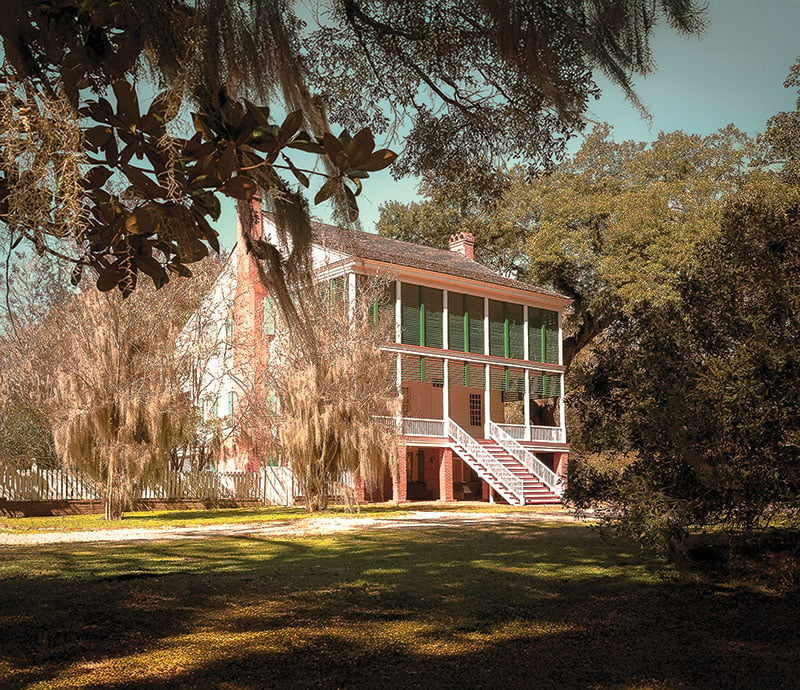
From sites around Oakley, Audubon and his apprentice Joseph Mason, aged roughly 12 or 13, collected foliage to render the native environment. Returning to their quarters, Mason illustrated the flora while Audubon put his taxidermy skills to practice. He then posed and painted the birds in life-size detail. Visitors to Oakley can step inside their reproduced quarters on the ground floor of the main house. The space includes two beds, a desk, cabinet and specimen bag. It’s one thing to see an original painting, another to encounter the place where the artist lived and worked, slept and dreamed. At Oakley, the visitor can do both.
“He’s the crown selling point for us,” says Jones. From the books on the table, she looks up at Audubon’s prints, original lithographs, nearly a complete set of the 32 he painted during his time here. Even when reproduced as thumbnails on a computer screen, Audubon’s birds arrest a viewer’s attention. At 38 x 26 inches — the size of the originals that crowd the conference room walls—they carry a heightened charge. And that’s precisely what Audubon intended. Rather than reproductions of rigid, dead specimens, as artists had previously illustrated birds — “a manner he would find all too common in conventional ornithology,” as William Souder writes in “Under a Wild Sky: John James Audubon and the Making of ‘The Birds of America’” — he depicted each in natural poses. By doing so, he gave us new ways to comprehend the natural world.
The disordered books on the table are on a human scale. They’re not the double elephant folio of the original “The Birds of America” — a staggering four-and-a-half foot wingspan when open, or the length of the Statue of Liberty’s nose. Friends of Oakley board member Joseph L. Boneno approaches the table and reads several titles: “Insects and Diseases of Trees in the South,” “A Management Guide for Invasive Plants in Southern Forests,” “Southern Hardwood Management.” They have nothing to do with Audubon — and yet. At Oakley, everything orbits the artist’s legacy.

Today, the grounds at Oakley cover 100 acres.
With pressures of development in West Feliciana Parish threatening to endanger that legacy, the Friends of Oakley have engaged in an endeavor, at once urgent and endless, to protect the land. “There’s the house, the historical artifact that you can see and touch,” Dart says. “But there was willful disregard of the grounds from the beginning.” Some of this has to do with cotton, infamous for causing soil degradation, erosion and nutrient depletion.
As the land suffered, so, too, did the house. From the beginning, Oakley’s owners were women, four generations in all. The last of them, Lucy Mathews, lived alone in the main house from 1930 to 1947. Dart describes the maintenance challenges: a four-story house with 17 rooms, its sole occupant a septuagenarian.
The Friends began asking questions: How do we preserve this land? How do we protect it? Another problem, in the wake of the global pandemic, involved a decline in annual visitors to Oakley while figures at Rosedown Plantation, less than two miles north of St. Francisville, continued to increase. All discussion led the Friends back to the same place: the four months when the artist lived here.

As part of its Vision Plan, Waggonner & Ball envision Oakley House as a gateway to an expanded Audubon Experience — foregrounding the site’s ecologically diverse landscape through restoration, enhanced access and stewardship.
“He’s what distinguishes us from every other place,” says Jones. “There’s no question that he was deeply inspired by the landscape he roamed while living here.” In that inspiration, the Friends found the seed for their mission. Return the land to the virgin forest filled with beech and magnolia, poplar and oak, that Audubon knew and loved. With help from the cross-disciplinary architecture and environment practice Waggonner & Ball, they began working on a master plan.
“Restoring it to the era before Audubon situates the landscape over time,” Dart says. “And that is what makes this project unique. Nobody does this in the South. In European countries, yes, but not here.” The Friends understand the glacial process of this work, which they call a “100-year mandate.” A century from now, they say, their legacy will reveal itself in every tree larger than two inches in diameter.
The titles of the books on the table contain the key to the first steps to this “forever project.” To begin, they must eliminate invasive species, including vines, shrubs, and trees that impair the forest’s long-term sustainability. “We need to identify the trees we can leave standing,” says Jones. “Having a storm come through to knock down invasives wouldn’t be a bad thing, but if that doesn’t happen, we will just have to let the invasives fall.” Next comes the planting of native vegetation and hardwood trees, the creation of new wetlands and enhancement of existing ones, also the restoration of the site’s meadow and savanna.

While living at Oakley, Audubon worked and slept in a room on the ground floor of the main house.
At the Waggonner & Ball offices in New Orleans, Sophie Riedel and John Kleinschmidt ponder their plans to “amplify the Audubon experience” at Oakley. “There is a quest for authenticity that is never as straightforward as one hopes,” Kleinschmidt says. “Can we bring the landscape up to the attention that’s been paid to the architecture?”
Riedel leans forward. “There’s a productive tension to recreate what it was like when Audubon lived at Oakley,” she says. “If we’re going to do anything to the landscape, how can we make sure it’s sustained over time? How do you make the most out of the visitor’s experience? How do you weave artifacts you find or learn about into the experience and make them part of the exploration of the site?”

The key to doing so often resides in old maps, Kleinschmidt says. In Audubon’s case, he found it in writing. “Audubon wrote a journal entry about woodpeckers that would hop up bricks in the room at Oakley,” Kleinschmidt says. He captured two red-cockaded woodpeckers, bringing one back to his room, where he placed it in a wooden cage. The woodpecker escaped and scaled the bare brick wall.
“The snippet of the woodpecker goes straight into our work,” Riedel says. On a professional level, Audubon’s journal entry riveted Riedel. It revealed details about the original walls in Audubon’s room. On a personal level, she decided to design her Halloween costume around Audubon, stepping out as the artist, with a woodpecker perched on the brim of her hat.

Four generations of women owned Oakley Plantation. Today, visitors can explore its restored interiors.
“When architects preserve a building, few people get to visit the construction site,” Kleinschmidt says. “More often, things happen behind a curtain, with the unveiling only after years of planning, production and work. But landscape changes over time. It becomes this dynamic, evolving place.”
“Rarely does a building evolve like a landscape does,” Riedel says, noting that returning visitors to Oakley will be able to witness gradual changes to the grounds.
Single-minded in their mission, the Friends of Oakley remain certain and patient. “The refocusing and revitalization of hardwood forest, the removal of invasive species — to bring this land back to the precolonial era would be a service to Audubon, the legacy of naturalists and for the next generation,” Wilcox says. Jones, who is 82, agrees. “I won’t live to see the results of what we’re doing.” Her hope echoes that of Riedel and Kleinschmidt: this work will serve as a model for other historic sites, and that enhancements at Oakley will pave the way for the site to become a National Historic Landmark.

While working on “The Birds of America,” Audubon painted more than 400 distinct species to scale. All told, he painted more than half of North America’s native birds.
Fitting for a place named after Audubon, these plans will also improve avian habitat. Along the one-mile hiking trail that starts behind the Visitor Center, a chorus of birdsong fills the air. Mockingbirds, cardinals and hooded warblers flutter through hickories and oak, sycamore and magnolia. You hear the song around the main house and other preserved structures, the cookhouse and cabins, the garden and barn. It’s there, constant, in the parking lot, where four male cardinals, ignoring their territorial tendencies, perch within 10 feet of one another to offer a soft symphony, here on these grounds where Audubon became Audubon.