The Ultimate Day Trip to St. Martinville
Nestled along the scenic Bayou Teche, St. Martinville is steeped in the complicated and beautiful heritage of Louisiana’s various cultures, home to the first of Louisiana’s State Parks and the best place to get fried gator.
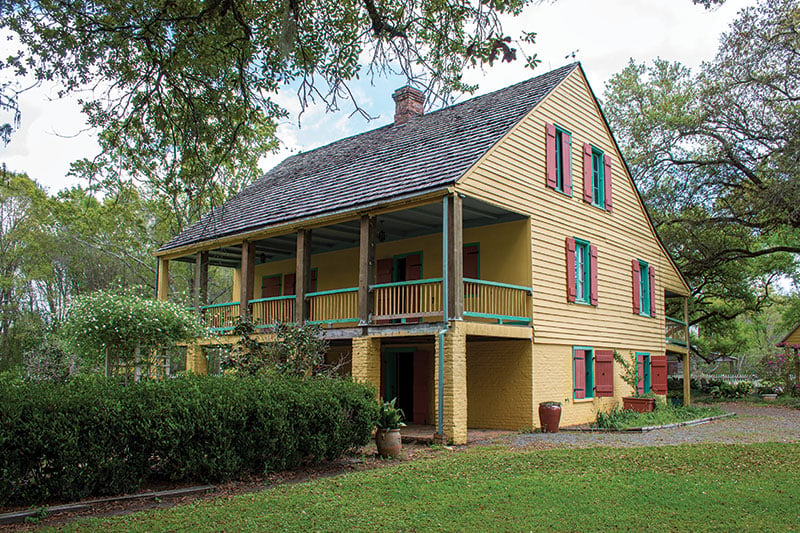
Wandering through Maison Olivier, the circa 1815 Raised Creole Cottage-style plantation house at the Longfellow-Evangeline State Historical Site, it’s easy to get the feeling you might bump into a member of the Olivier family. The home is decorated and staged as though the family — and people enslaved by them — are still in residence. This is my favorite type of museum, because it’s like time traveling and being plopped into another lifetime, à la the late ‘80s/early ‘90s TV series NBC’s “Quantum Leap.” Thus began my day in St. Martinville.
My husband and tried-and-true travel buddy, Mark, couldn’t join me on this jaunt to the seat of St. Martin Parish, which meant I could nerd out on the house museum without interruption and at my leisure. The home is in pristine condition, so much so that I had to return to the visitor’s center to confirm it isn’t a reproduction. The visitor’s center also confirms that the site was once part of the hunting grounds of the Attakapas Indians. There are, in fact, two reproductions on the site’s grounds, an Acadian cabin and Acadian farmstead (complete with longhorn cattle), but Maison Olivier is indeed historic.

Nestled near the plantation home, behind a white picket fence, are an outdoor kitchen and bread oven, and slave quarters. A barn is situated closer to the road. The site also includes a nature walk with countless “save the bees” signs, as well as chimney swift towers and a pollinator meadow. I’m not going to go too deeply into the rich and complicated history and detailed descriptions here, because every Louisianian (and tourist and transplant) should visit. Upon leaving, I saw a group unpacking picnic gear from their car and had regrets for not having had the same idea.

Once I started tucking into a big mess of fried alligator, corn and crab bisque, buttery yeast rolls and a large sweet tea at The St. John Restaurant (about a three-minute drive from the state historical site) overlooking Bayou Teche, my picnic regrets were long gone. It has been nearly a decade since Mark and I first dined at St. John, and we still talk about the fried alligator, because until then, we didn’t entirely care for this particular local delicacy. Too chewy, to be honest. I relayed this tidbit to my server, Jennifer, as I gushed about the flavor and tenderness of their version of the dish. Jennifer says it’s because they use jaw meat, which is either true or — in hindsight — she was messing with the out-of-towner. If it’s the latter, she got me!

After lunch, I walked over to the charming Studio Gallery & Coffee Bar for a cuppa to go and made my way to Evangeline Oak Park. The sweet little park on the bayou is home to the beloved oak tree immortalized by Henry Wadsworth Longfellow in 1847 in his epic poem “Evangeline.” The poem offers a fictitious account of the Acadians’ exile by the British from Nova Scotia in the mid-1700s. My visit was in March and happened to coincide with the Acadian Memorial Heritage Festival. During my visit to the park, a live band provided Cajun music as a soundtrack for my walk. I highly recommend engineering your visit similarly if, like me, you appreciate ambience.
History buffs will also want to make the short walk (or two-minute drive) along the Teche to the St. Martinville Cultural Heritage Center, home to the African American Museum and the Museum of the Acadian Memorial.

Impressive longhorn cattle are among the non-human residents at the Longfellow-Evangeline State Historical Site’s Acadian farmstead reproduction. Downtown, the monument of an Attakapas man acknowledges that this area along the Bayou Teche was originally home to the Indigenous Attakapas people before the French created the Poste de Attakapas settlement, now known as St. Martinville.
Next, I made my way a few blocks to Main Street to take in the circa 1836 Saint Martin de Tours Church, which is the third-oldest Catholic church in Louisiana and one of the oldest in the United States. The verdant grounds also include the historic Presbytère and other buildings and monuments. The church faces a row of shops and businesses on Main Street, including Abathecary, an all-natural bath and body store, and YaYa’s Boutique, which has gifts and a coffee and tea bar, as well as pastries.
By now, it was high time I hopped in the car to make the two-ish hour trek back to New Orleans. But not before sending photos of that tasty fried gator and a few scenic snapshots, including one of the otherworldly longhorns, to Mark with texts letting him know he missed out on a day of culinary delights, history and adventure. Dear readers, I’m sure you won’t make the same mistake.

Evangeline Oak Park is home to the beloved oak tree immortalized by Henry Wadsworth Longfellow in 1847 in his epic poem “Evangeline,” as well as a bust of the writer. The nearby circa-1836 Saint Martin de Tours Church, which is the third-oldest Catholic church in Louisiana and one of the oldest in the United States, includes the historic, and stately, Presbyter on its grounds.
Location
St. Martinville
1700s
In the mid-1700’s, what is now known as St. Martinville was called Poste des Attakapas. The area along the Bayou Teche was originally home to the Attakapas people before the French created the Poste des Attakapas settlement.
1765
After being expelled from Nova Scotia by Great Britain, Acadian exiles arrived in Louisiana, as part of what is known as the Grand Dérangement.
5,379
According to the 2020 Census, St. Martinville has a population of 5,379. While charmingly small, it is not the smallest town or city in the parish. That distinction goes to Arnaudville, with its population of 1,518.