“A Musician’s Dream:” SLU Professor Played at Rockin’1000 U.S. Debut in New Orleans
Plus Behind-the-Scenes Questions Answered
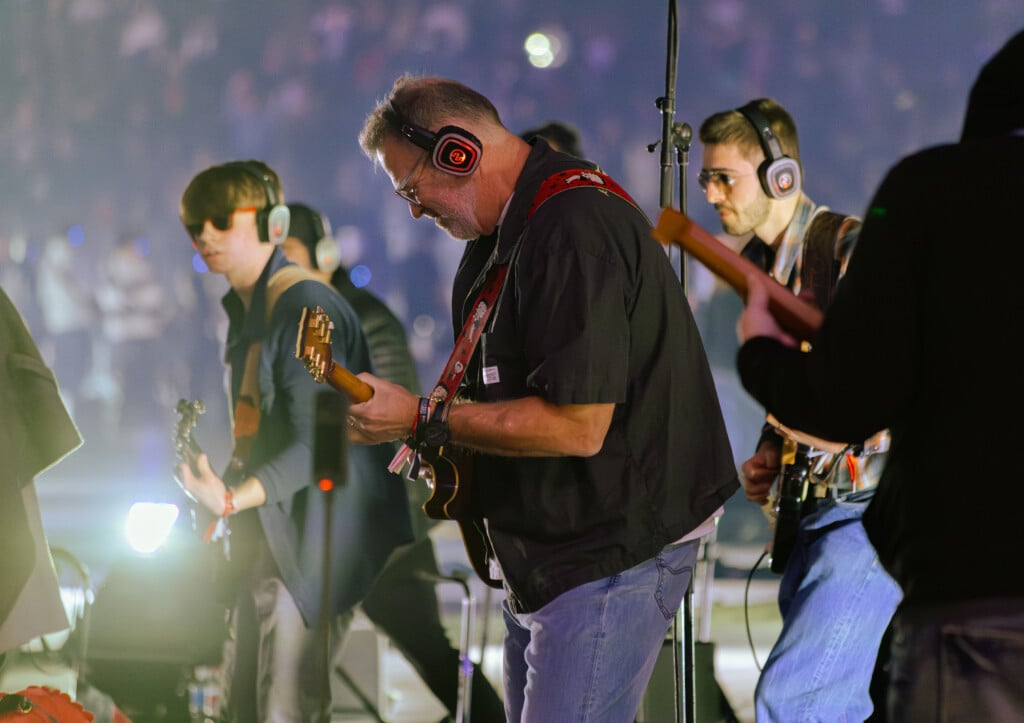
Last Saturday, a vast Caesars Superdome filled with electrifying sounds from 1,000 musicians, creating a unifying performance that the U.S. had never experienced before.
Yet, arguably even more incredible was the collective roar of the crowd that poured from the stands, sending a shock wave of sound through the chest of every musician on the floor.
This is how Dr. Joe Burns, Southeastern Louisiana University professor and communication department head, and electric guitarist at the concert, describes what it was like to perform at the Rockin’1000 U.S. Debut in New Orleans.
Rockin’1000, which started as a joke in founder Fabio Zaffagnini’s hometown in Italy, is now a global phenomenon of musicians from around the world coming together to play in major venues.
“When we finished ‘Smells Like Teen Spirit,’ the crowd went ballistic,” said Burns.
Describing that first roar, Burns said, “I’ve never had it directed at me. I’ve been in the dome. I’ve heard it, but it was–I don’t know how to say it–it blew through you.”
“You could feel that you had lungs,” Burns said. “To have them all screaming at you was shocking.”
Burns, who’s been playing music since he was 10 years old, has released four albums available on streaming services, played several gigs, hosts a ‘Rock School’ radio show for Southeastern’s KSLU and more, and yet has never experienced that rock star feeling until now.

Joe Burns, Photo by Alyssa Schiaffino
And that’s exactly what Zaffagnini intended Rockin’1000 to be.
Zaffagnini shared that after his initial viral video that started it all, he and his friends said, “Okay, let’s do concerts in stadiums just like rock stars, even if there are no rock stars involved. There are just common people playing music and being good at playing music.”
Beyond the high of the performance, Rockin’1000 also created a sense of community and purpose, with musicians from 26 countries and 48 states.
Burns shared that he and the surrounding musicians constantly shared tips. “We were each other’s tutors,” said Burns.
Burns even became a part of a group of musicians that went to lunch and dinner together outside of practices.

Photo from Joe Burns
“It was a musician’s dream,” said Burns. “Everybody wanted to talk. Everybody wanted to be your friend. Everybody wanted to talk about their life and where they were. And I mean, there’s something to it. We were all there for a set purpose.”
“The only thing I wish I’d have done differently is, I didn’t dress up,” said Burns. “I dressed the way I’ve always done to go on stage.”
Yet, his outfit–jeans, comfortable shoes and a Southeastern KSLU t-shirt overlaid with a work shirt–perfectly embodied who he was. It represented where he’s from. And that is part of the beauty of 1,000 musicians of all different backgrounds, ages and skill levels coming together.
Together, they create a collective moment that’s both unforgettable for the audience and the musician. It really is a “musician’s dream.”

Joe Burns, Photo by Alyssa Schiaffino
Behind-the-Scenes Q&A With Joe Burns
Q: How did you first hear about Rockin’1000? What was the signup process like?
A: It came across Facebook. And it said, if you want to be part of it, and I wanted to be part of it. But the fact that it was the first time it’s ever been in the United States, I just thought, well, there, that’s the reason to do it. And it said, you know, go sign up at the website, which I did. And then there’s a membership fee. You have to join to be in it, wasn’t much. I think it was a £100 or a €100. I don’t remember, because it’s a European thing. But came out to about 120 bucks. And I paid it, and then it said, here is your guitar contact. Put together an audition tape and just send it to him. Make sure you tell them what you want to do. Do you want to teach? Do you want this? Do you want that? Couple other questions you have to answer. Can you read tab? Can you read music? And I just sat down, set up a guitar, and just freestyled for about 3.5 minutes.
Q: What does the leader role do?
A: Once they said yes, you’re on the field. You’re one of the 1000. Once you did that, you then had a couple of opportunities. One would allow you to be sort of a leader. So, I guess what they would do is put players with somebody who’s only been going for a year or something like that. Or you could be one of the people who would be straightforwardly mic’d. And I was of the opinion that I’m just doing this for fun. I do not need to be the highlight of the show. So, I just played, which was what the absolute majority of people do. I can only talk about what I saw on my side. I think there were 7 guys up at the front that were mic’d. And then the rest of us backed them up.
Q: How long did it take for them to get back to you on whether you were selected or not?
A: Oh, almost immediately. I’m going to guess three days.
Q: And can you talk about that process of preparation before the concert?
A: I think they put up half of the tutorials first and told you, take the next couple of weeks, three weeks, and learn these. And then more will come. What I did was download the song, like from the actual artist and downloaded the sheet music, which they give you. And then, I don’t know if you noticed, but everyone was wearing headphones. There’s a click track. And it’s just that, it’s the song that clicks in tempo. It’s created with like synthesizers. So they can make, you know, if I want the drums to do something, they can bring the drums up. If they want the base to do something, they bring the base up. But, you know, we would sit there, and we would play, and it [the headphones] would say, “Guitars left, one, two, three, go,” and you were to know what those things were.
Q: Was there anything particularly challenging?
A: It’s not that it was so challenging–because we can all play the chords–it’s the idea of, you have to understand, you’re with a 1000 people. You are not the show. You’re the support cast, and you have to be very concerned about dynamics. Like “Proud Mary” starts off nice and slow. You can’t just be pounding out chords. Or once they get to the real fast part, you have to be able to bring it up somehow. And, you know, if you start at ten, you can’t exactly go to eleven.