Three Remain
Les Petites Maisons of Istre Cemetery
“I can’t find my French music,” says Shane Vincent. And then, so there’s no confusion about where we find ourselves, geographically or culturally, he repeats his name: “That’s Vansohn.” In the 90-degree shade, he’s pacing between two burial sections at Istre Cemetery. Five months earlier, he and other volunteers started construction on a new pavilion here. Now, he’s back to paint the foundation. But first he needs his radio, and it’s not where he left it.
Scanning the cemetery, Vincent stops his search and gestures to one grave after another. His family members, several generations of them, lie buried here, also there. “Someday I’ll be here too,” he says. Then he points out recent work he and other volunteers have completed at this cemetery in the southwestern nook of Acadia Parish. There’s the statue of Christ, so brittle the arms and fingers were falling off, the chest split open when he found it in the cemetery. Vincent patched it with epoxy and mixed cement. It now rises above the concrete altar that collapsed and which he repaired with rebar and more epoxy. He runs his palm over the altar’s flawed surface, a Cajun version of wabi-sabi, the grace and beauty that Japanese find in imperfection.

“Everybody tells me, ‘But you don’t get paid for all the work you do,’” Vincent says. “I say, ‘That’s not what it’s about. This is about family.’”
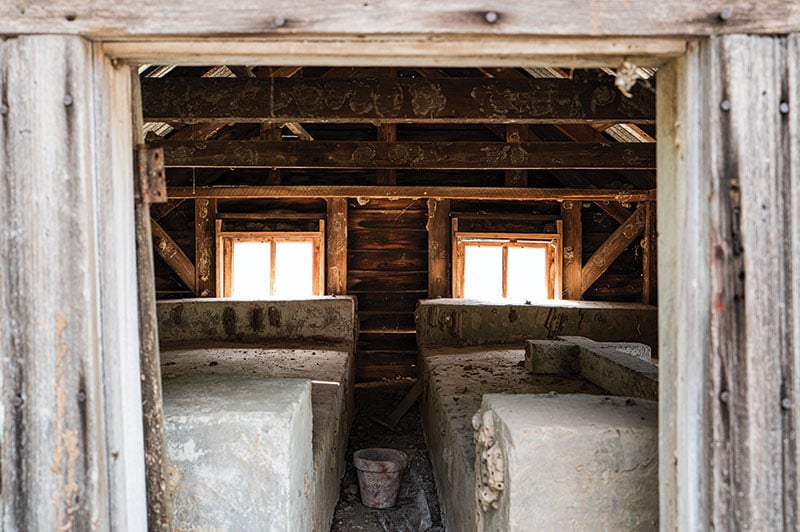
At the sound of a car entering the arched entry with the cemetery name, pronounced “east,” in large letters overhead, Vincent turns to watch an SUV approach. Out of it step two members from the family he’s been describing, one so vast that Shane and his cousin Derek need Derek’s wife, Catherine, to help them weed through the exact lineage. As members of the Krewe de Feaux, Derek and Catherine hold an annual auction to raise money for the cemetery’s preservation. In 2008, three distinct architectural structures — Les petites maisons, or the little houses — earned Istre Cemetery a listing on the National Register of Historic Places. In their 2009 documentary, “Little Houses,” Donny and Zach Broussard estimate that nearly 40 of these structures once stood here. Three remain. They are the last known of their kind in Louisiana.

“The grave houses were a common site in country cemeteries across Acadia, Evangeline and northern Vermilion parishes through the 1930s,” writes Jeremy Broussard in “Grave House Legends.” The oldest at Istre Cemetery dates to around 1900.
The little houses contain what you would expect from a typical home in South Louisiana: cypress beams, metal or shingled rooftops, hinged doors, windows and inside, candles, rosaries and religious icons. Besides the three historic houses, there are three newer structures, each built to honor the dead and protect them from the elements. That’s how locals tell it. The origin of the houses, however, remains a mystery.
Despite its historic importance, Istre Cemetery relies completely on donations and volunteers for all maintenance. “We give back to the community,” says Derek Vincent, President of Istre Cemetery. That community also gives. Besides participating in an annual cleanup day, friends and neighbors gather here for the most solemn moments during Carnival Season.

The stop at Istre Cemetery marks a high point in the routes of Krewe de Feaux, a Mardi Gras parade with floats and no horses, and the Cadien Toujours Courir de Mardi Gras de l’Anse, the traditional Cajun “run” with no floats but horses and chickens galore. During the latter, all carousing ceases when revelers cross the cemetery threshold. They remove their masks and capuchons and gather before a priest. For the sole time during their bacchanal, there is no dancing, no drinking, no mischief. There are prayers, somber songs, all in Cajun French. Then the Mardi Gras and capitaines and band members disperse to visit graves of ancestors, some of whom lie buried in les petites maisons.
As president of Istre Cemetery, Derek Vincent uses funds from the annual auction and donations from the community for necessary preservation. He also recently purchased 134 U.S. flags that now fly throughout the cemetery. Derek and Catherine check on those that have faded or frayed, noting that they will need to buy new ones after next year’s auction. Then they say goodbye to Shane. Car doors close. Tires crunch across the gravel road, onto asphalt, and the cemetery welcomes a new sound. First comes the accordion, next a fiddle, then a voice, high-pitched, wailing in Cajun French. With the handle of a paint roller in one hand, Shane Vincent bends to adjust the volume of his radio. The music rises, rhythms that those buried here would easily recognize. Then he gets to work.
Parish: Acadia
Did you know? In 2009, Donny and Zach Broussard released their documentary about Istre Cemetery, “Little Houses” –— co-written with Zach’s brother Jeremy, whose book, “Grave House Legends,” examines the grave houses at Istre and considers similar structures called grave shelters found in Protestant cemeteries in the Upland South. Grave shelters typically lack sides and are not fully enclosed. The grave houses at Istre, on the other hand, resemble their moniker. Their origin remains a mystery.
In the documentary, after viewing photographs of the grave houses at Istre for the first time, cultural geographer Dr. Greg Jeane says, “I have been a student of Southern burial landscapes for over 30 years. I have never seen anything like this.”