Last Night at the Rue Bayou is Just Beginning
Rue Bayou Offers an Immersive Post-Fest Nightcap
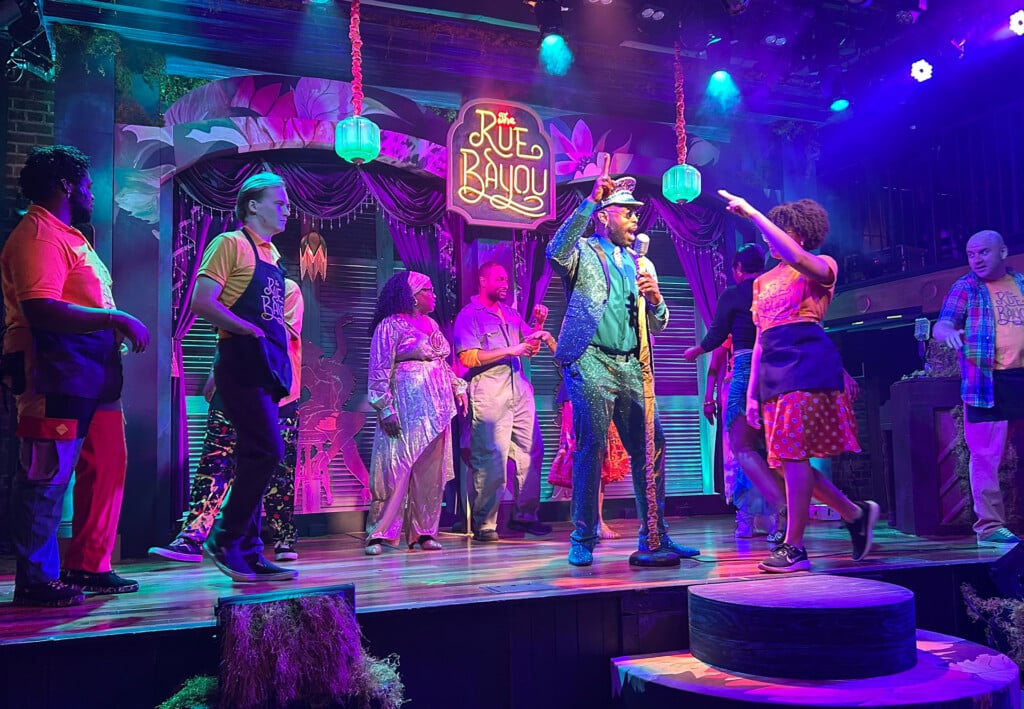
“This is an original show—I’ve never done anything like it before,” said Deri’Andre Tucker, who plays cocktail server La Fonda in “Last Night at the Rue Bayou.” “It has a mythical feel to it.”
As the French Quarter fills music fans after a day of festivals, many may feel a relaxed nightcap may be in order, and the “Rue Bayou” nightclub’s marquee at the shabby-chic playhouse at 4 French Market Place—seemingly hiding in plain sight across from the market itself—will enchant them into an interactive musical experience.
For those looking for live music, wanting alternative entertainment such as a stage play and still others preferring a traditional New Orleans lounge to chat with friends and maybe meet friends, they will have discovered all of those aspects and more. Patrons—along with those interested in a night on the town and craving a more intimate non-festival-related activity—should stroll down to the French Market’s gaslit street and see “Last Night at Rue Bayou” to experience all of that and more.
The efforts to capture a more authentic depiction of New Orleans on stage—and off—are evident even with the extraordinary talent cast locally. Indeed, Last Night at the Rue Bayou is largely comprised of home-grown Louisiana talent. Like Deri’Andre Tucker and Donald Jones, Jr., many of the performers are born and bred in the Crescent City with Broadway chops. Having tripped the light fantastic in Manhattan and on touring companies, their Playbill credits include being in the original cast of “Chicago,” “Frozen” and “Aladdin,” as well as touring companies for “Rent” and “Ain’t Too Proud.”
“When other actors in New York City learned I was from New Orleans, they would always ask, ‘Do you know Donald [Jones, Jr.]?’ and ‘ Did you hear about Donald?’ I finally met him right before the pandemic, so when I was home visiting a few months ago, he contacted me about ‘Rue Bayou’.”
“The show walks a balance between spirituality and debauchery,” adds Donald Jones, Jr., who does a Sinners-style double turn playing two roles—the morally ambiguous Reverend Beaucoup while also embodying voodoo legend Papa Legba. The Gentilly native admits this show helped him “become more aware of the history. I fell in love with coming home.”
“I have a more open attitude about receiving this history guiding my ancestors–how resilient they truly are,” Jones says, reflecting on how he infuses his respective characters in the show. “Fire, flood, politics, economy are all part of this story as well.”
And so will the audience.
The Club is Now Open
The subtle entry door transports patrons back in time to the elegant Storyville “Rue Bayou” nightclub. New York-based producers Mark Rubinsky and Tony Castrigno and their creative team successfully accomplished their vision of recreating “a shopworn, spellbound New Orleans music club—part blues joint, part sanctified refuge, home-away-from-home where everyone is family, a friend or a friend-to-be.”
Prior to the show, audience members should expect to be warmly greeted by a welcoming staff, including attentive servers, offering two local cocktails and some tasty gumbo. Owner of “Rue Bayou,” Miss Ilean Durand (Kadeja Oné Higdon) may also pass by to welcome you and share some of the club’s storied history. Several other friendly people attending the performance may also chat with people, some of whom, like the staff, may or may not be characters in the play. This immersive experience engages the audience to be personally invested in this show, unlike most stage productions.
“I don’t typically engage with audiences,” Jones says of the improvisational aspect in this show. “I was in an improv troupe in college, but was insecure and not ready to talk.” He seems to have conquered that challenge.
As the mingling characters cleverly roll out the plot, it will become apparent that night after night, the “Rue Bayou” is the New Orleans hot spot for the regulars. When corrupt Parish Commissioner Junior Robicheaux (Andrew Michael Anotine) issues an eviction notice during the supper club’s revelry, the “Rue Bayou” community (characters and now audience alike) rally behind owner Miss Ilean to protect their spiritual home-away-from-home—and all that it implies.
“It captures the voodoo part of our culture in New Orleans. In this story, voodoo is used for good,” Tucker says. “Writer Michel Meth does a good job of presenting all aspects—music, food, spiritual—in a unique story.”
It’s likely not a coincidence that the Gov. Nicholls Street intersection turns into Bayou Road in Treme and the Seventh Ward—aka “Rue Bayou.” The subtlety demonstrates the commitment to authenticity that the New York team producing the show infused into this production to New Orleans.
It was their proven focus on making the show as authentic to the culture as possible that convinced the local actors to get on board—especially happily forgoing French Quarter Fest and Jazz Fest to contribute to the flavor of the show.
“Last Night at the Rue Bayou” performances run Thursday to Sunday through Sunday, May 3.