The Search for the Holy Grail of Laughter is Found in “Spamalot”
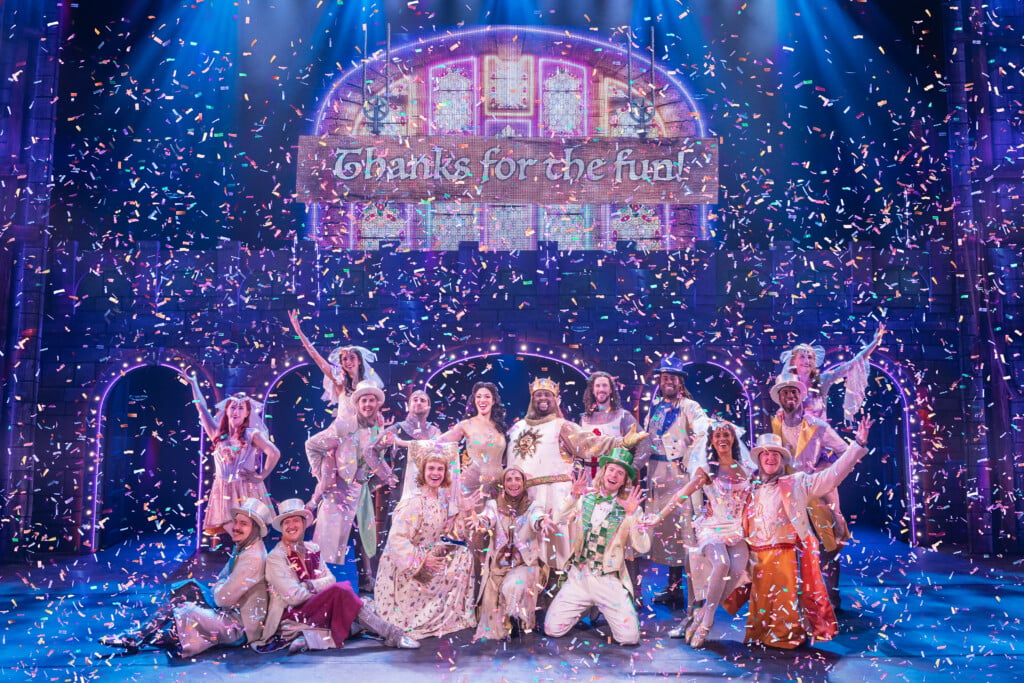
The famed “Monty Python” comedy troupe’s off-color, inappropriate and otherwise unapologetically politically incorrect humor of “Spamalot” has theatre fans equally shocked and aghast, as much as they relished the irreverent fun. “Spamalot” is less a retelling of Camelot and more of a reinvention, or perhaps reimagination, laced with a heavy dose of self-reverential meta—and not the digital company.
At its core, this show brilliantly modifies the popular “Monty Python and the Holy Grail” film into a properly improper stage extravaganza. Even though it gratuitously steals plot points and teases with unrealized lead-ins from well-worn Broadway classics, the film’s tale of King Arthur’s quest for the Holy Grail remains solidly intact.
King Arthur (Major Attaway) is combing the countryside with his “faithful man-servant” Patsy (Blake Segal), recruiting men worthy of serving as “Knights of the very, very, very, very Round Table” in the Las Vegas-esque Camelot. Along the way, Arthur is reunited with The Lady of the Lake (Amanda Robles), an alluring water fairy who is as much a self-aware diva as she is an enchantress. She tasks him with recovering the grail to fulfill his purpose. He is up to the task along with his knights, including “dashingly handsome” Sir Galahad (Leo Roberts), the “homicidally brave” Sir Lancelot (Chris Collins-Pisano) and the less-than-brave Sir Robin (Sean Bell).
With some meandering subplots that are hysterically called out by the Lady of the Lake, the play hits the film’s highpoints. It also manages to cleverly infuse songs and gags from other “Monty Python” fan faves such as Life of Brian (“Always Look on the Bright Side of Life”) and “Meaning of Life,” as well as the “Flying Circus” TV series — “Spam, Spam, Spam, Spam” anyone?
As expected, the lines are fast and furious. The result evolves the wildly popular, well-known movie into a stand-alone stage musical, without losing the unexpected fun and merciless skewing of, well, everybody.
“SPAMALOT” SPOILERS AHEAD:
It’s said, “there are no small parts, just small actors,” which makes Chris Collins-Pisano a giant on stage, elevating every “bit part” he plays into scene-stealing slapstick gold. As Sir Lancelot (“His Name is Lancelot”), the leader of the Knights Who Say “Ni!” and especially as the French Taunter (“Run Away”), his non-verbal improv instincts make his secondary characters dominate every scene. And the audience’s response to his talent was evident.
While the film had a distinct dearth of females given the storyline, writer and “Monty Python” alum Eric Idle was inspired to expand the Lady of the Lake to a sort of leading love interest in the stage adaptation. While similar rewrites have created parts to include actresses for female representation in the casts of other play adaptations from male-centric source material, The Lady’s addition to the show infused seamlessly and seemingly necessary to the point that it’s almost impossible to recall how the part did not exist beyond a submerged arm in the movie.
But as strongly written as the role is, Amanda Robles brings it to new levels of excess—in all the best ways. With a powerful voice that surprises, Robles takes the Lady’s love-lorn Diva ego to new heights, melodramatically and vocally. Her rendition of “Diva’s Lament” is a brilliant showstopper—when she literally stops the show—to belt out her criticisms of the play, most notably her absence on stage in the entire second act up to that point.
Likewise, her duet with Leo Roberts’ Sir Lancelot opens as a romantic Broadway ballad with both voices in lovely harmony. The love song unexpectedly devolves into the Broadway metaverse at every verse, with the characters gradually realizing they are trapped in an unending song because the orchestra keeps escalating drama.
And that is where the show really starts tripping the light fantastic. The film had a parallel storyline in modern England that broke the film narrative between Arthur’s Medieval quest. Where the stage production excels is not by keeping the spirit of that opposition but by doubling down on the meta awareness as it clues the cast in on the fact that they are in a twenty-first-century historical lecture. Unlike the film’s abrupt ending, the show is able to intensify the effect with audience participation to actually offer a conclusive end.
But you might want to stay for the curtain call, anyway. Just a thought.
“Spamalot” is at the Saenger Theatre through Sunday, June 7.