“A Knock At My Door:” Reminiscing with Chef John Folse
The story of Chef John Folse and Ms. Mary Ferchard is a beautiful memory of tragedy, hope and love from a different time.
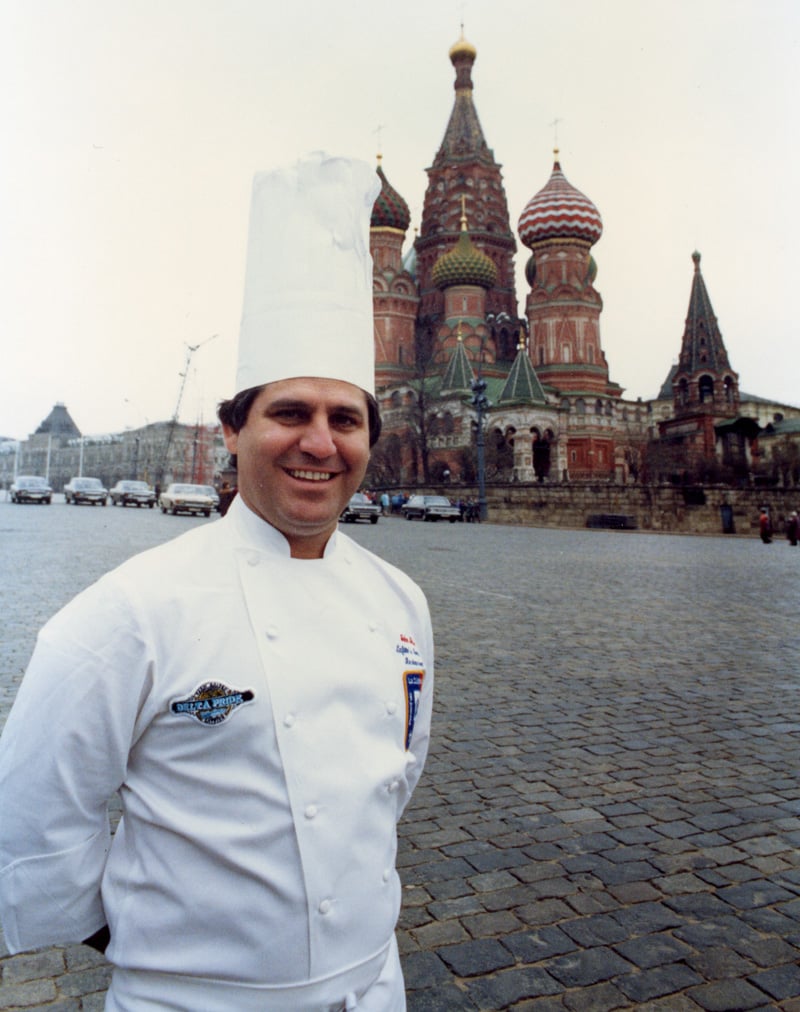
Chef John Folse in Moscow, 1987
On July 9, 2026, Chef John Folse celebrated his 80th birthday. Author Miguel Savoy, a ninth-generation Louisianan from Mamou, La., interviewed Chef Folse as he reminisced on his upbringing.
The rain was falling down hard in old St. James when Mary Ferchard looked across the yard and saw a young woman struggling to pull her children’s laundry from the clothesline.
The woman Mary saw was nine months pregnant, visibly anxious and tired. In her lifetime, Theresa Folse would have eight children to feed, clothe, bathe and care for.
“Ms. Mary,” as Chef John Folse affectionately remembered her, saw Theresa from across the yard and approached her.
Mary urged Theresa to get out of the rain, reassuring her. “Go inside, sweetheart. I’m going to take care of this.” It was a simple act of kindness, among the many that never enter the public record.
Yet sometimes an entire life can turn on just one small gesture, long before its meaning is ever fully understood or appreciated. But Theresa did understand it. She grabbed Ms. Mary’s hand. “If anything ever happened,” she said, she hoped “a woman like her” would step up to care for her children.
Three days later, on May 11, 1955, Theresa Marie Zeringue Folse died in childbirth. She was 37 years old. Chef Folse was the fourth of eight children, and at their young age, grief was difficult to understand.
He would later remember the response of the community in St. James to his mother’s death not as an afterthought or distant courtesy, but as an overwhelming expression of love and compassion.
“I’ll never forget, even as a young child, the response of our community,” he recalled, “to wrap kindness around my daddy and all the eight Folse children.”
People came with baskets of goods, teddy bears, vegetables and whatever else they could carry.
“It kept going,” he said, as if the love itself had no end. “We didn’t have time to grieve,” Chef Folse remembered, “because it was somehow the most loving time in our life.”
While their mother was being buried, the house filled with so much tenderness that the children did not yet realize they had lost “the greatest gift” of their lives.
To them, it just felt like one of the great gatherings of old Louisiana.
Chef Folse said it was not unlike “a big boucherie,” because so many people, neighbors and strangers alike, came together in their time of need.
Then Mary Ferchard knocked on their door: a Black Creole woman in St. James Parish, walking into a white man’s household, where people lived close enough to one another in ways that are difficult to understand today.
South Louisiana had its own customs, boundaries and contradictions. French language, faith, and poverty brought people of all backgrounds into daily contact, but none of those things erased the racial and political lines drawn by the painful memories of the past.
Through it all, Ms. Mary cared for the Folse children, as she washed, watched and corrected them each day. Most important of all, she loved them, though at supper time when dinner was served, her first instinct was to step outside rather than sit at the table.
“Come eat, Ms. Mary,” Chef Folse recalled saying.
“She raised us. We loved her, and she loved us like a mother would love her own sons.”
Ms. Mary Ferchard
Years later, when Chef’s brother Dave graduated from high school, Mary called their father. “My job is done.”
After all the years of social and political progress following Mary Ferchard’s simple act, today people are somehow farther apart.
In 2026, only one in four Americans know their own neighbors, nearly two-thirds believe racism remains widespread and majorities in both political parties describe their counterpart as “immoral.”
A collective anxiety has taken hold that asks whether Ms. Mary would exist today.
Would she help that poor woman in the rain? Would she even feel safe enough to approach her or introduce herself?
With all the material and political improvements of modern life, America has simultaneously become more separated, suspicious and alone.
The story of Chef John Folse and Ms. Mary Ferchard is a beautiful memory of tragedy, hope and love from a different time.
It also asks whether Americans divided by race, class and politics can still look beyond their faults and see their needs.
On the morning of June 6, over coffee, Chef John Folse leaned back in his chair and moved through the years of his life, drifting from St. James to Rome, from the old river road to the Reagan-Gorbachev summit in Moscow, Russia.
He reminisced about cooking ducks with Pope John Paul II; of food, faith, and of all the beautiful places that Louisiana, and God, have carried him.
Rising from the swamps of St. James, Chef Folse carried Louisiana culinary art across continents and conference rooms, into state dinners, universities, books, television, restaurants and popular culture.
His life has stretched farther than anyone attending that “boucherie” in 1955 could have possibly imagined.
“But who made all that possible?”