Louisiana Film History and Culture
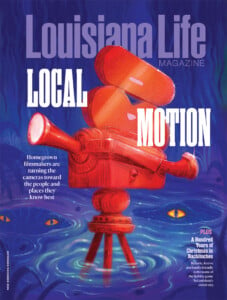
For more than 100 years, Hollywood has used Louisiana to tell its stories. Now, homegrown Louisiana filmmakers are turning the cameras toward the people and places they know best.

There are few places on Earth quite as cinematic as Louisiana. Surely that’s why filmmakers have been traveling down the long-forgotten bayous and wetlands of the state for over 100 years, looking for just the right glimpse of a perfect swampland sunset amid the sway of Spanish moss.
Since the earliest days of movie-making, there has been a fascination with Louisiana: its mystery, its seduction and its cultures. But even then, the first film made here was not about the people, the songs, the soul; it wasn’t even set here. That movie was, in fact, “Tarzan of the Apes” in 1918, a black-and-white silent film shot near Morgan City, doubling for an African jungle. Hollywood’s outsider perspective, which rendered not only the state but the people in it through a reductive, racist and ignorant lens, often ran roughshod over the 20th century, with films romanticizing history while distorting it, presenting the artifice of Louisiana without interrogating or honoring it.

“When I think of film history in Louisiana, I see this tension between local filmmakers who are interested in shedding light back on a larger culture versus outside filmmakers who want to work kind of exacerbate that difference,” says Todd Kennedy, Toups Endowed Professor of Cultural Studies at Nicholls State University and author of “Anthony Bourdain, Filmmaker.” “I think it comes from a nation that is overly homogenized and wants to exoticize any difference they can see.”
Even today, after over 100 years of film history and 25 years of a tax incentive-based filmmaking boon, most of the productions that set down stakes in Louisiana use it merely as a backlot, a blank canvas that can be rendered as fantastical or mundane as need be. Need a “Jurassic World” sequence? There’s a parking lot for that. Need some swampland for “Where the Crawdads Sing” in North Carolina? Try the Northshore of Lake Pontchartrain. Still, while expatriate producers parachute in and out of the state, adding paltry fuel to a waxing industry that has scattered thousands of craftspeople due to the whims of penny-pinching studios, there is still a batch of homegrown creatives, following in the footsteps of filmmakers like Glen Pitre (“Belizaire The Cajun”) and, even in his own quirky way, Tommy Wiseau (“Big Shark”), who know the true Louisiana and wanted to share it with the world.
The New Orleans Film Festival (NOFF) is the premier showcase for Louisiana films and filmmakers across the state, providing a platform not only for exhibition but, more importantly, the fostering of a community that celebrates and reinvents itself with each story told. As programmers for the festival cull through hundreds of submissions each year, their eyes are peeled for a new voice, a new shade to cast upon the collage of Louisiana filmmaking which, more often than not, is something wholly unique.
“When it comes to New Orleans films and Southern films as a whole, there are no two alike”, says Lizzy Doria, a narrative features and southern shorts programmer for the New Orleans Film Festival and filmmaker. “ I think Louisiana filmmakers are not as influenced by the studio world and prefer experimentation in our films. That’s why going to our festival feels so exciting because the patchwork quilt it creates is so distinct.”
Louisiana’s film culture is in many ways fed by its active collegiate programs, where young filmmakers are incubated and given the freedom to tell the stories that mean something to them without the obligations of seeing cinema as capitalism. And their output has proved fruitful, leading the NOFF to create a category exclusive for college short films due to the onslaught of well-deserving entries from LSU, UNO, Dillard, Tulane, and more. But filmmaking in Louisiana is far from a young person’s game, as directors like Michael Murphy, a seasoned documentarian and New Orleans native, often bring their latest films to the festival to show off for their peers and collaborators. In many ways, that coming together of artists is the purest purpose of the NOFF and festivals like it across the state. It’s part reunion and part catalyst, a chance for like minds to ping-pong off one another to create the next film that furthers the story of Louisiana in the minds of audiences everywhere. According to Rashada Fortier, NOFF narrative shorts programmer, and Clint Bowie, artistic director for the New Orleans Film Society, it’s not uncommon to see the directors of one film be the production assistant to another; a symbiotic and generously selfless flow of ideas that springs forth when the end game of creation is art for its own sake.
“At its core, filmmaking is a collaborative process, and it’s the nature of New Orleans and Louisiana at large to build communities,” says Fortier. “As someone who’s worked in New York and worked with people who’ve come here from our commercial projects from LA, there’s something unique to New Orleans: the willingness to do what is needed to make a film happen, whether that be your big studio features or your friend’s short that you’re doing in two days on a weekend.”
Nobody makes a movie alone, especially a feature film, and there are quite a few independent narrative features produced in Louisiana each year, including “West of Greatness: The Story of the Westwego Muscle Boys,” “Beware The Box Folk” and “Cowboy,” just to name a few recent examples. But there could be more, and these filmmakers need champions, producers who see the vision of what Louisiana movies can and should be. Jason Waggenspack, founder and CEO of The Ranch Film Studios, a partner in Neutral Ground Films, and the current president of Film Louisiana, has been doing his part to enrich the local film community for decades and has now committed himself to telling Louisiana stories on a grand scale.
“We’ve seen so many films that have used the state as a character but the tax credit system also allows films to go from concept to creation entirely in Louisiana,” says Waggenspack. “That’s why we started Neutral Ground Films, to tell great stories in Louisiana. If we can connect those stories with an audience, we’ll be able to tell even more.”
The first project in the Neutral Ground Films slate, a documentary about a Baton Rouge drug smuggler during the Iran-Contra scandal, is in many ways befitting the split personality of Louisiana on film, as a “Hollywood” version of the same story was also filmed here: the Tom Cruise vehicle “American Made.” Though the outlook for film production to rise to its former glory seems bleaker as the years roll on, it’s hard to imagine a world where Louisiana will not be presented on movie screens in some way or another, and it will be filmmakers who live and work here who will make it happen in the most meaningful and profound ways.
“Filmmakers at the end of the day are culture bearers. If our culture is to survive in the face of global warming and homogenization in America, I don’t think film’s going to cause that,” says Kennedy. “But I think it can at least help us understand, and at the very least remember, what’s being lost.”
While there are still songs to be sung and stories to be told, the Louisiana film community will continue to thrive, just so long as we enrich our storytellers with the power and the privilege they deserve, by laying out our collective memory across celluloid to be immortalized on the silver screen.

Jared Cliff LaReau
Hollywood may have overlooked Westwego, but one independent filmmaker sees a community with stories worth telling.
Making movies matters. That’s how communities are built, artistry is evolved and filmmakers find their voice; as Jared Cliff LaReau, director of the Westwego set “West of Greatness: The Story of the Westwego Muscle Boys,” can attest. An Arkansas native whose passion for filmmaking was sparked by seeing “Apocalypse Now” at the technically inappropriate age of 10, Jared sought out a new home in New Orleans in the aftermath of addiction recovery, seeking a scene of artists and craftspeople that he could enmesh himself within. There, he discovered a team of friends, actors and craftspeople willing to take on a seemingly impossible filmmaking odyssey and, most surprising of all, a fascination with the people living in a place that Hollywood would never think to shine its lens; the oft-ignored working-class community of Westwego.
“I went to Westwego for the first time when I was camera operating on a friend’s short film, and thought it was wild looking,” says Jared. “There are these pipelines along the river and abandoned factories alongside this cute small town. This felt like my hometown to me, and I found this instant kinship with the West Bank.”
Jared wanted to tell stories that spoke to who we are. “West of Greatness” fit that bill, and allowed him and his found family of creatives, to cross-pollinate reality and fiction into a film that, in both story and style, manifests a groundbreaking hybrid of both.
Filmed over 18 months, “West of Greatness” follows a group of young men hoping to win a $15,000 prize for the fabled “Greatest Gains” bodybuilder competition in Westwego. While many of the competitors are fairly well built, hobbyists if not professional gym rats, the heroes of the film are not. Terry (Zachary Van Zandt) and Jerome (LaEric Moore) are skinny, yet are fueled by the blind hope of pushing themselves to become something bigger, literally, than their current selves to achieve the lives they’ve always dreamed of.
“I watched ‘Pumping Iron,’ and this documentary called ‘Hands on Hard Body,’ about a group of people in Texas who had to keep their hands on a truck, and whoever kept their hands on the longest would win the truth,” says Jared. “I thought this was incredible. This is human desperation, the lengths that they would go through to sacrifice their own dignity for a dollar. I didn’t set out to mix those flavors, but one day I envisioned my friend LaEric growing muscles as a time-lapse. And then, the next day, the idea had become a bodybuilding film set on the West Bank.”
The filming of “West of Greatness” required just as much ingenuity, dedication, and skill for the filmmakers as it did the competitors. Instead of faking a bodybuilding competition, they invented one with a real cash prize. Instead of expecting their actors to train on their own to reach the desired physique, they paid them up front and followed their progress over the course of months, documenting their trials, failures and camaraderie in real time. The film created from that experimentation is deeply intimate, brutally affecting, funny, tragic and triumphant; one that, while celebrated, has yet to find a traditional means of distribution. Still, whether “West of Greatness” ultimately finds its place on movie screens or, as Jared muses, is released for free online — a punk rock middle finger to the traditional corporate structures of distribution — the myth of the Westwego Muscle Boys is sure to outlive any box office receipt or festival run. Because money was never the point, the art was, the community was, and that dream is only growing more and more real every day.
“I want to create a Louisiana infrastructure,” says Jared. “How do I establish a studio system here that is independent, where other people can work on each other’s stuff and make a living? That’s why we are building a co-op of creators. I want to be a part of the crew that makes Louisiana film for Louisiana filmmakers.”
As Jared continues his work in political advocacy through his company Something Human, along with his latest film project, a neo-noir about a nun taking on the carcinogen-spewing overlords of Cancer Alley called “The Revelation of Sister Theodora,” the torch of blind hope that fueled the birth of this rapidly expanding film family feels primed to continue pushing independent film in Louisiana to new heights of greatness.

Carly LeDay
By connecting artists, encouraging collaboration and championing local talent, Carly LeDay is helping build a stronger independent film community in Louisiana.
It’s difficult to pin down precisely what a film producer does because in many ways they do it all. Part coordinator, part manager and ever-present cheerleader, the multifaceted discipline of a producer has always felt somewhat innate for Lafayette native Carly LeDay, even as a small child.
An entrepreneurial spirit manifested early through an eagerness to put together themed events and productions; a “Cheetah Girls 2” party most notably, and even as an adult, that same itch to match like-minded artists together for something larger than themselves has evolved into a desire to foster an independent film community in Louisiana, one where leaping before looking not only is preferred but is a prerequisite for entry.
“I’m naturally timid, but I wasn’t able to pierce the flesh of people until I started to advocate for myself and for the collaborators that worked with me,” says Carly. “I began telling people that it doesn’t matter if you’re a student or have even gone to film school. We are the roles that we say we are. If someone’s a writer, say you’re a writer; not I’m ‘trying’ to be a writer.”
After establishing herself in the independent film community by producing several short film projects during her time at LSU, Carly’s role as facilitator of Louisiana filmmakers has already spread internationally with the showcase of the short film “There Are Flowers Outside The Door,” written and directed by Emma Rabé Johnson, at the Cannes Film Festival in 2025, which she also produced. That whirlwind experience ignited a spark in Carly, a need not only to return to Cannes again, but to do so with a team of Louisiana creators and filmmakers in tow; an indie movement kickstarted by passion with a passionate advocate leading the way.
“I love meeting different people, whether it’s background actors or hair and makeup artists, and hearing their stories; whether it’s on indie productions or big budget sets,” says Carly. “It’s kind of crafted my mindset where you can go work in Atlanta or LA, and probably you’ll have a great time working there, but this is still your home. There are still people here that want to do amazing creative things in this community. That’s why I like surrounding myself with people who are alive, who don’t listen when someone tells them they can’t do something.”
As with any art scene, whether it be music or film, community comes first: A person knows a person, recommends someone else and someone settles in the middle connecting dots of personalities and skillsets who can see the big picture. That is the artistry of a different, if deeply necessary sort, that facilitates the whole of a project by combining specialized craftspeople and visionary creatives to create kismet. For Carly, the project itself is irrelevant; whether it be a short film, music video, documentary or commercial, it’s the connections that mean the most, that rubbing together of like minds to spark something new, exciting and revolutionary. And that kind of dedication isn’t so much a job as a calling.
“I’m on call 24/7 for different things, for different departments,” says Carly. “I like to say that I’m a creative producer because I’m going to be the one on a tech scout with key creatives; I’m going to be able to go to the director and say, ‘What do you want from me.’ My job is to be a liaison between departments.”
Through her production company Cheateaux Rouge Cinema, and a sweeping social media presence where she can share her journey and insights, Carly’s work continues to grow and evolve, seeking out interesting and eager collaborators willing to connect and grow the local film scene one project at a time. For Carly, that’s the name of the game: helping filmmakers flower into the best versions of themselves and offering space for them to proclaim who they are through the stories they craft together.
“I love the indie film scene. I think a lot more people are making their own films and they’re proud of it, showcasing their amazing work without hiding behind anything,” says Carly. “What we need right now above everything else is each other.”
Louisiana Film Timeline

1918: “Tarzan of the Apes,” the first adaptation of Edgar Rice Burroughs’ pulp hero, is filmed in Morgan City, Louisiana.

1964: “Hush … Hush, Sweet Charlotte,” starring Bette Davis, is filmed outside Baton Rouge, Louisiana; a classic in the burgeoning “hagsploitation” genre.

1969: “Easy Rider,” directed by Dennis Hopper, is filmed in Morganza, Louisiana, and New Orleans during Mardi Gras. The film helps kickstart the “New Hollywood” movement, where low-budget and revolutionary films rewrote the rules of narrative storytelling.

1973: Roger Moore hopscotches across crocodiles in his first outing as James Bond in “Live and Let Die.”

1986: Louisiana native Glen Pitre brings the legend of an Acadiana folk hero in “Belizaire the Cajun.”

1989: Natchitoches becomes the fictional Chinquipin Parish for Dolly Parton, Sally Field and Julia Roberts in “Steel Magnolias.”

1989: The landscape of independent film changes forever with the release of “Sex, Lies, and Videotape,” a Baton Rouge-shot, Cannes Film Festival Palme d’Or-winning darling written and directed by Steven Soderbergh.

1991: Oliver Stone casts a web of conspiracy that films right in the same locations that Lee Harvey Oswald lived and walked in “JFK.”

1997: Kasi Lemmons’ American Southern Gothic drama “Eve’s Bayou” is released and will, in 2018, be selected by the Library of Congress for preservation in the United States National Film Registry.

2012: Quentin Tarantino’s “Django Unchained,” starring Jamie Foxx, Kerry Washington and Leonardo DiCaprio, paints the National Historic Landmark Evergreen Plantation in Edgard, Louisiana, red with revenge.

2013: “Beasts of the Southern Wild,” a fantastical coming-of-age story set in the bayous of South Louisiana, is nominated for four Academy Awards: Best Picture, Best Director, Best Adapted Screenplay and Best Actress.

2013: “12 Years A Slave,” directed by Steve McQueen and starring Chiwetel Ejiofor, earns three Academy Awards: Best Picture, Best Adapted Screenplay, and Best Supporting Actress.

2017: The Essence Music Festival is the setting for a wild weekend in New Orleans with Regina Hall, Tiffany Haddish, Jada Pinkett Smith and Queen Latifah in “Girls Trip.”

2025: Ryan Coogler unleashes undead terrors and recreates Clarksdale, Mississippi, just outside New Orleans in the critically and financially acclaimed blockbuster phenomenon, “Sinners.”

Emily Moss Wilson
From homemade horror films to Hallmark holiday favorites, Louisiana filmmaker Emily Moss Wilson has built a career bringing Southern stories to the screen.
For Emily Moss Wilson, a lasting career as a filmmaker can be traced back to a derelict camp on the outskirts of Lake Charles where, with the help of some friends, a pair of VHS players and the madcap mania of youth, she made her first film, a “terrible” pseudo-slasher film called “Spring Break.” While more of a slice of life novelty than a nail-biting slasher, the film showed gumption, inventiveness and charm which, powered by the iridescent radiance of a young artist finding her voice, would prove the catalyst for Emily’s future as a trailblazer of a genre that has come to define an entire subculture and holiday season: the “My Southern Family Christmas” movie. Having directed nine Christmastime films for Lifetime and Hallmark channels, along with several thrillers and a love story based around the lives of Lisa and Al Robertson of “Duck Dynasty” fame, Emily’s skills were forged through grit, grime and gumption, as well as the tutelage of famed filmmaker Gary Marshall. While working as his on-set script coordinator in Los Angeles, a highly specialized position whose sole focus was the upkeep and evolution of the film’s screenplay, Emily witnessed firsthand from the “Pretty Woman” and “The Princess Diaries” director the value of spinning stories meant to be embraced and beloved by an audience.
“I’m not trying to make a movie for me. I’m trying to make a movie for people to watch and enjoy,” says Emily. “Gary always had the audience in mind. He started in television where the audience was literally watching you film and reacting in real time. I think I carried that with me. As a filmmaker, you have to sit in the seat of your own film and try to see it from their perspective.”
After cutting her teeth with an acclaimed “Twilight Zone”-style short film and a Lifetime thriller starring “Dolphin Tale” star and future frequent collaborator Austin Highsmith Garces, Emily returned home to the Gulf South to direct a Christmas movie titled “Christmas in Mississippi”; puréeing a hard-won story sense with the secret sauce of her own Southern heritage. While Christmas movies of this ilk had become seasonal mainstays, setting one in the South was certainly not the norm. What does a Southern Christmas look like anyway without the snowfall and sleigh rides? For Emily, that incongruity, that gap between expectations and the lived experience of growing up in the temperate winters of no-snow Christmases, was the soil from which something unique could be fostered — a bespoke charm that can only be found when yuletiding in a uniquely Southern way. While the budgets were low, and the resources often meager, the independent spirit that fueled her earliest moviemaking manias always shone through, even when the weather decided to be uncooperative.
“I remember on our first day of ‘Hometown Christmas’ that we were out on a baseball field and it was like 102 degrees. Everyone was melting, and I was thinking how it was an incredible day one,” remembers Emily fondly. “I have a picture from another film, where all of our tents, our equipment, even my director’s chair, [were] floating away in water. It was the first day of a 12-day shoot and a true baptism by fire. We just lost half of the day, and your equipment’s literally floating away. We had to figure it out.”
Over the past decade, Emily certainly figured it out, finding novel ways of baking into her films that homegrown glow of the traditions and truths that made her own holidays so special year after year. With her help, the Currier and Ives canvas of Christmas has, for many, become a small Southern town; whether it be Lafayette, Ponchatoula or Gulfport, where coats are rarely worn, and food is synonymous with family. By highlighting these communities and the people who live and love there, Emily was able to not only bring jobs but also a global audience to communities for whom movie cameras were as anachronistic as snow. For Emily, though, it all comes back to story; the ones she tells and the ones she shares with the world about the place she once called home.