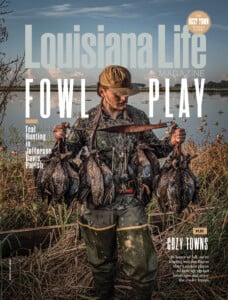
The Art of Teal Hunting in Louisiana
Teal hunting with the locals in Jefferson Davis Parish

It’s late September, 5 a.m. on opening day of teal season, and above a rice field in Jefferson Davis Parish, the constellations dangle like high–wattage chandeliers. Six half–awake hunters shuffle through the dark. They work methodically, loading decoys and shotguns into side–by–sides.
“Who’s got the bug spray?”
A moment of grumbling, followed by the tsk–tsk soundtrack of the Louisiana outdoors, and the can of repellent begins to make its rounds. On the other side of a fleet of pickup trucks, a screen door trills open. From the white wooden house spill several more camouflaged men. They saunter past rocking chairs, some pulling shirts over heads while others fasten straps and adjust pants.

Blue-winged teal are among the earliest ducks to migrate south in the fall and the latest to arrive on the prairies in the spring. As the LDWF reports, “The U.S. Fish and Wildlife Service allows zones and splits to provide separate hunting regulations in areas of states with different habitats, species composition, and migration chronologies.”
“Nice new hip boots.”
“You like my kit.” Pausing as though he’s reached the end of a fashion runway, the hunter lifts his heel. “They’re brand new.”
Closer to the rice field, another hunter paces and mutters to himself. “I got my gun,” he says. “I got my shells.” Austin Bertrand approaches a side–by–side and slides his palm over his shotgun. “I got my gun. I got my shells.” After a brief pause, he repeats that last word, this time louder and as a question: “Shells?”
Out of the dark, a muffled chorus responds in the affirmative.
“Guns?”
After further assents, the hunters decide to double check.

The second annual Greater Pine Island Teal Festival will be held in Elton on September 19th. Louisiana hunters often encounter the most teal in rice fields and in coastal marshes of the state’s southwest. River deltas also provide good teal hunting.
“Y’all need any more spray?”
Forgetting to bathe in bug spray before entering a flooded rice field in south Louisiana would be like forgetting to load the cooler with ice on Mardi Gras morning. And this morning, they’re not just preparing for the teal and togetherness that hunting provides even when the wild game won’t comply. They’re also here because of the spray.
Evan Veillon, Joe Treme, Gabriel Fontenot, Josh Regan and Jagger Morvant approach Bertrand. Some of them have been hunting teal together as long as they can remember, gathering beside rice fields throughout the parish and setting out in the dark with visions of bagged birds and banquets. But this year, opening day carries another charge. It coincides with the inaugural Greater Pine Island Teal Festival, a rice farming and crawfishing community in Jefferson Davis Parish. Many of the hunters wear hats and shirts with insignia of the festival sponsor, the Elton–based manufacturer of DEET–free, EPA–approved bug spray, Hunt Repellent — the very name brandished on the can they pass like a baton. Later today, there will be all the things any self–respecting Louisiana festival provides: live music, dancing, enough food to make you wonder why no politician has introduced a bill requiring hammocks for post–feast naps on all festival grounds and a squadron of workers who will pluck and clean as many teal as hunters from the region manage to score, the latter courtesy of Hunt.

In Louisiana, the first large flocks of migrant ducks appear in the coastal marshes in mid to late-October, the LDWF reports. Migrant ducks typically appear in the swamps and flooded forests of central and northeast Louisiana later in November or early December. Pintail, shovelers, gadwalls and green-winged teal generally migrate into coastal marshes earlier in the fall.
The engine purrs in the predawn dark. Warm dogs press into one hip boot after another, and Bertrand calls for Teche, his black Lab, to sit. Beneath his patient preparations, Bertrand betrays an excitement that’s a near–match for Teche’s. While duck season means seasons, starting on the calendar with teal before opening to wood duck, mallard, gray duck, redhead, pintail and, later, conservation goose, for Bertrand, things might as well begin and end with teal. A good day during Louisiana’s annual teal season means that he’s carved enough time to hunt every morning and afternoon. And nothing compares to opening day.
“They get smarter as the season progresses,” Bertrand says as he climbs into the side–by–side. The goal, then, that dream like a taste on the tongue for the other 350–odd days of the year, is to greet the teal while they’re still slow on the uptake.

The hunters climb in, including Teche — Teche, from the Chitimacha for “snake,” name of the historic bayou, the original 125–mile superhighway in Acadiana. It’s not what Bertrand’s wife, Bailey, had in mind when she told him they needed a dog with a bona fide French Louisiana name, but it’s about as Louisiana as South Louisiana gets. Bertrand’s father always used Richard A. Wolters’ 1964 book, “Water Dog,” to train his dogs, so what was good enough then was good enough for Teche, who begins to pace and yelp in excitement a quarter mile before the hunters reach the blind. A month ago, crawfish traps peppered this pond, a staple feature throughout the region from December through July before rice becomes ubiquitous. Rather than drain these ponds to plant rice, the landowner here worked with Ducks Unlimited on a waterfowl population management plan to provide a healthy habitat for ducks to migrate. “It’s good for the ducks,” Bertrand says as he cuts the engine. “It also makes good hunting.”
One by one, the hunters step onto a narrow levee between two flooded fields. With headlamps from the side–by–side lighting the way, they begin to check their motion decoy ducks. Within moments, wings begin to spin, mimicking pre–splash landing. Treme carries the first of four into the pond while Regan grabs two bundles of decoy ducks, a dozen in each, and wades out.

“How much time we got?”
Veillon turns to the first trace of light, nothing more than a faint brushstroke on the horizon. “Fifteen minutes,” he says.
The pace quickens. Decoys tingle. Plastic rubs against plastic like ice inside a glass. Bertrand cuts the lights, and Fontenot and Morvant glance up to see a dozen ibises. They hurl the decoys underarm until all are afloat.
“Guys, that’s a lot of model ducks,” Bertrand says. “Please don’t shoot them.”
A thin blanket of dew covers everything as the hunters lower themselves into a metal pit blind.
“That’s more manageable.”

The LDWF reports that banding studies from 1986-2012 show that more than a third of the banded birds killed in Louisiana were banded in Saskatchewan. Smaller percentages were banded in North Dakota, Manitoba, Alberta, Minnesota and South Dakota.
“First–class.”
“Who knew there would be a bench?”
“Anybody need shells?”
“Face paint?”
“Candy bars?”
“Coffee?”
“How did you get your leg over this?”
“If y’all want to put on a little subtle Justin Bieber, I’m good with it.”
At that, Morvant places the duck call to his lips.
“Keep your gun on safety.”
“Effing mosquitoes.”
“They want to get in my ears.”

To the west, half a mile away, multiple shotguns resound, five seconds of relentless report. The hunters turn their heads and stare in a combination of envy and awe.
“They’re going to war over there.”
Morvant returns the duck call to his lips.
“Last night, we listened to ‘Rooster.’ That song gets me pumped.”
From the east, in a sky ribboned in pink and gray, they begin to descend, blue–winged teal, the second smallest duck species in North America. No one shoots.
“Take the shot next time, son.”
“Pass me that mosquito dope.”
“Look alive.”

“Right there.” Six heads swivel toward a coil of teal. One blast follows another.
“How did we miss that?”
“My scope must be off.”
More blasts resound from the adjacent field.
“How do I get in that blind?”
Above them fly eight roseate spoonbills, a majestic formation. Another congregation of ibises follows in their wake.
“They got too many other birds over here.”
A pair of teal approach. The hunters raise their shotguns. After six blasts, one teal drops into the water.
“That was an expensive bird.”

Wood ducks and black-bellied whistling ducks are also common during the September teal season. As the LDWF reports, “Mottled duck populations are declining in our state, and they are particularly vulnerable during September. The USFWS has made it clear they will not consider adding black-bellies or any other species, to the September teal season bag limit.”
“Single to your right.”
“There’s another one.”
“Keep the gun hot.”
“Hot, right. I’m about to drink this pond water.”
“I’m about to shoot this dragonfly.”
Two hunters aim, shoot and miss.
“He ain’t coming back.”
Three more teal arc overhead.
“Boys, get ’em.”
They hesitate over who should shoot.
“Y’all work it out.”
“On three. One, two…”

For the next 15 minutes, like clockwork, teal approach from all directions. The hunters aim, fire, and teal plunge into the pond. Teche works like a boomerang, unclenching his jaw in pride before Bertrand to offer one bird after another. In a brief lull, they fall back into memories of the previous night.
“That shrimp creole was so good I tried eating somebody else’s.”
“That maque choux.”
“How many cans of corn was that?”
“Everybody’s colon’s gonna be cleaned out.”
More teal approach, more misses.
“We some good shots in this group.”
“There’s nothing worse than hearing ‘no’ after you shoot.”
“Sometimes I like to miss so I can shoot again.”
“I’m going to get an ear infection.”
“That mosquito dope works good.”
“I think it stopped the birds.”
Rapid gunfire echoes from the nearby field, another sustained rumble.
“Man, what are they doing over there?”
“I think something died in this blind.”
“Something’s gotta go, either this smell or me.”
“I hope I can hear my accordion later.”
“I have that song ‘Rooster’ in my head right now.”
“How did we shoot so many when we missed so much?”
“How’d I get so dirty? I’ve been sitting on this bench the whole time.”

It happens in a flicker. By 7 a.m., less than an hour after they slipped into the blind, each hunter has reached his daily limit of six. There’s something about their pace, as they gather the birds, that makes it seem like whatever else happens next, the best part of the day has already faded, the anticipation upon waking, the venturing out with friends in darkness to wait for the sun to rise, and nothing to do but talk and wait some more — and to do all of it together. Then another impulse takes over. They begin taking pictures of one another holding teal.
“Y’all make sure you get Hunt in the picture,” says Fontenot, co–founder of the repellent company with the slogan “DEET is Dead.” And one by one, they pose all over again, this time laughing for the camera.

Two hours later, a Hunt Repellent–branded limousine, complete with camouflage exterior, pulls into the parking lot at Bon’s on Main Street in Elton. Beyond the limousine, gathered around blue garbage cans, a dozen men and women pluck teal. Feathers swirl like snow in the humid morning. Forty seconds per duck, 50, and they pass the birds to three women who wash the meat at an industrial sink.
Hunt co–founder Burns Mulhearn moves among the workers. They started at 8 a.m. An hour later, festivalgoers, many of them still in camouflage from the morning’s hunt, have begun to spill from the doors of Bon’s. They carry beer and cracklins, sharing their bounty with the pluckers and washers before stepping back inside to enjoy the music. After a few songs, their cleaned teal are ready.

Noon comes and goes, and then it’s 3 p.m., 90 degrees in the September shade. By now, the crew has been working for seven hours. Mulhearn records the tally: 1,015 blue–winged teal; one lone green–winged teal. All the while, Bertrand, Morvant, Fontenot, Treme, Regan and Veillon stop to chat with friends and family. Fragments of conversation fall, much as earlier in the pit blind, only now the hunters stand in this baking parking lot. A minute here, another there, and they weave through the swelling crowd.